NICU
NICU
The Birth of Masimo: How Project Stork and SET® Pulse Oximetry Revolutionized Neonatal Care
Learn how Masimo Founder and CEO Joe Kiani took his dream of advancing pulse oximetry & turned it into a global company with more than 5,500 people dedicated to improving patient outcomes. With Project Stork and the development of SET® Measure-through Motion and Low Perfusion™ pulse oximetry, Masimo solved seemingly unsolvable problems and made a significant impact on neonatal care, helping clinicians reduce the incidence of retinopathy of prematurity (ROP) and improve critical congenital heart disease (CCHD) screening. With contributions from Joe Kiani, COO Bilal Muhsin, Dr. Mitch Goldstein, Dr. Vijay Dhar, and more.
O3® Regional Oximetry
O3® Regional Oximetry
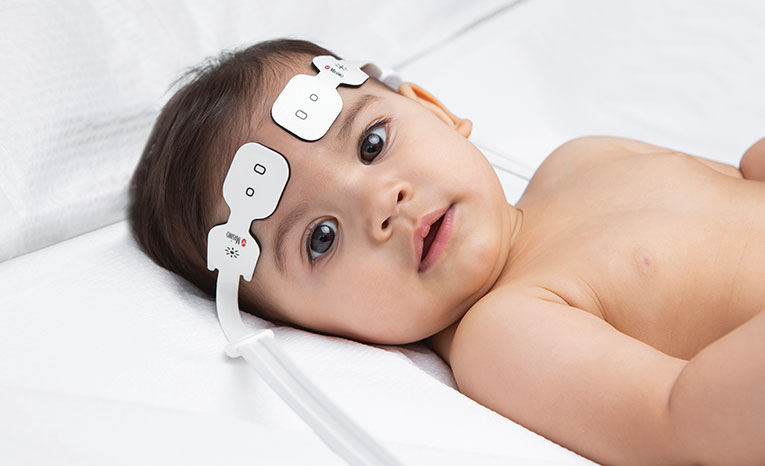
O3 Regional Oximetry uses near-infrared spectroscopy (NIRS) to enable monitoring of tissue oxygen saturation (rSO2) for cerebral and somatic monitoring sites.
- Helps clinicians monitor cerebral oxygenation in situations where pulse oximetry alone may not be fully indicative of the oxygen in the brain
- May detect hypoxic threats in tissue under the sensor—delivering critical information to inform effective treatment decisions10,11
- Noninvasive and continuous measurement with trend accuracy of 3% ARMS* for neonatal patients
Capnography Solutions
Capnography Solutions
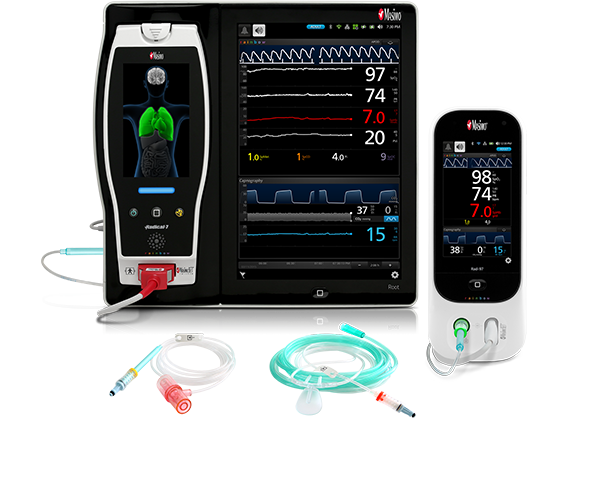
Masimo offers a portfolio of sidestream capnography solutions to meet the challenges of ventilation monitoring in the NICU. Sidestream CO2 monitoring works with a full family of NomoLine® sampling lines, airway adapter sets, and cannulas for use in a variety of clinical scenarios, including intubated and non-intubated patients in both low and high humidity applications. NomoLine technology is designed for low-flow applications, with a very low sampling rate of 50 ml/min, supporting use on patients with low tidal volumes and high breath rates, common characteristics of neonatal patients. Masimo capnography seamlessly integrates with Masimo SET® pulse oximetry and other key physiologic parameters, providing clinicians with greater visibility to a patient’s oxygenation, ventilation, and respiratory status.
References:
- 1.
Masimo. Clinical Evidence. https://www.masimo.com/evidence/featured-studies/feature/.
- 2.
Shah et al. J Clin Anesth. 2012;24(5):385-91.
- 3.
Saugstad et al. Journal of Perinatal Medicine. May 2006.
- 4.
Castillo et al. Prevention of retinopathy of prematurity in preterm infants through changes in clinical practice and SpO2 Technology. Acta Paediatr. 2011;100(2):188-92.
- 5.
Chow et al. Can changes in clinical practice decrease the incidence of sever retinopathy of prematurity in very low birth weight infants? Pediatrics. 2003;111(2):339-345.
- 6.
Ash-Bernal R et al. Medicine (Baltimore). 2004;83(5):265-73.
- 7.
Riou Y et al. Pediatric Research. 1998;43:295.
- 8.
U.S. Food & Drug, Consumer Updates, Benzocaine and Babies: Not a Good Mix.
- 9.
Annabi EH et al. Anesth Analg. 2009;108(3):898-9.
- 10.
Yu Y et al. J Biomed Res. 2016;30(1):1-4.
- 11.
Greenberg SB et al. J Crit Care. 2013;28(3):270-6.
*ARMS accuracy is a statistical calculation of the difference between device measurements and reference measurements. Approximately two-thirds of the device measurements fell within ± ARMS of the reference measurements in a controlled study.
RESOURCES
The use of the trademark Patient SafetyNet is under license from University HealthSystem Consortium.
SpMet monitoring is not intended to replace laboratory blood testing. Blood samples should be analyzed by laboratory instruments prior to clinical decision making.
Caution: Federal (USA) law restricts this device to sale by or on the order of a physician. See instructions for use for full prescribing information, including indications, contraindications, warnings, and precautions.
PLCO-004256/PLM-12624A-1220